case study 05 · domain protection
Locking down a domain that never sends email: F to A in four records
The problem
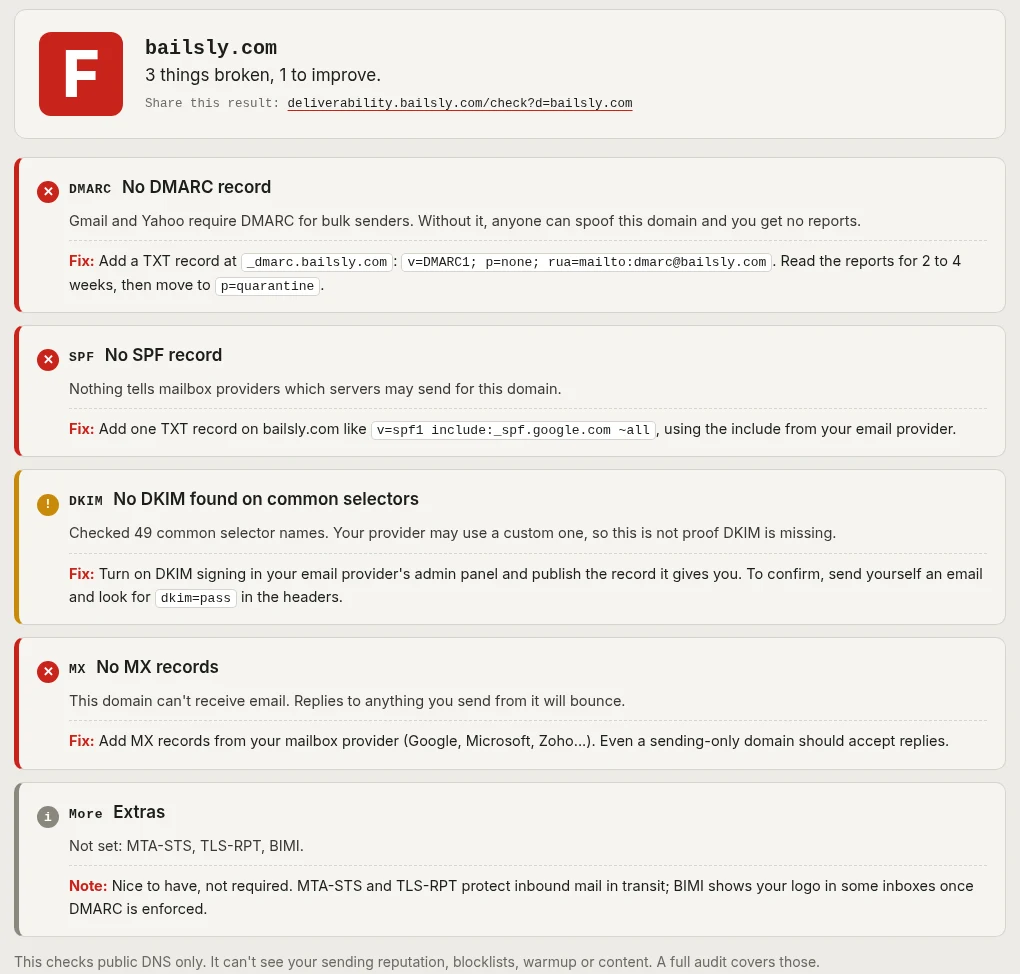
bailsly.com is one of our own domains. It hosts web apps and nothing else. No mailbox, no newsletter, no app that sends email. So it had no mail records at all.
That sounds harmless, but it isn't. With no SPF and no DMARC, receivers have nothing telling them to reject a fake. Anyone can send email "from" the domain, and mailbox providers will often deliver it. Domains that don't send mail get spoofed for exactly this reason: nobody is watching them.
What we did
- Confirmed first that nothing sends or receives mail on the domain or any subdomain. Every record was a web app or a tunnel, with no MX and no TXT
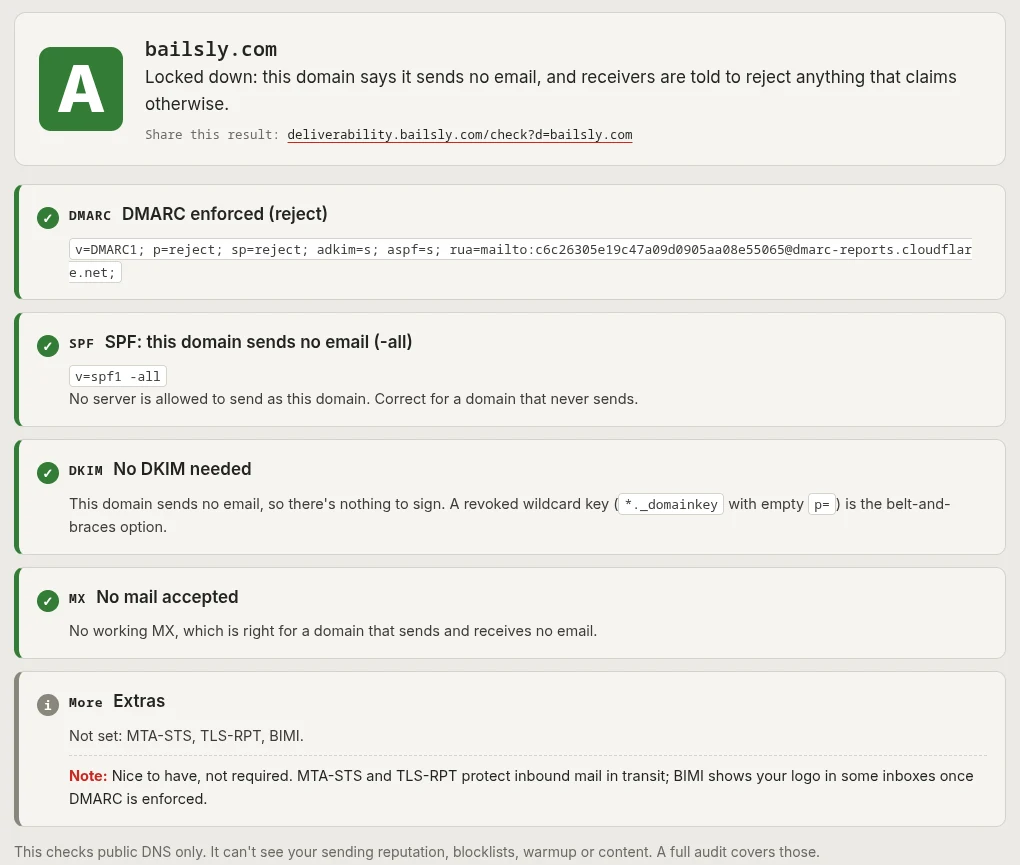
v=spf1 -all: no server is allowed to send as this domainp=reject; sp=rejectwith strict alignment: anything claiming to be the domain, or any subdomain, gets rejected- A null MX (
0 .): the domain accepts no mail, so senders get an instant clear failure instead of retrying for days - A revoked wildcard DKIM key (
*._domainkeywith emptyp=): no DKIM signature can ever validate - Turned on DMARC reporting, so spoofing attempts show up in a dashboard instead of going unseen
The catch nobody mentions
Cloudflare's DMARC Management adds its own report address to your existing record. When we ran it, the preview showed the new record as ...aspf=s rua=mailto:..., with no semicolon between the two tags. Our original record didn't end in a semicolon, and the wizard just glued the new tag onto the end.
A record like that doesn't fail loudly. Receivers read aspf as having a junk value, and depending on the parser they ignore the tag, ignore the reports, or ignore the whole record. We cancelled, added the trailing semicolon, and reran it. The final record parses cleanly. That's the kind of thing you only catch by reading what a tool is about to publish instead of clicking Next.
✓ Domain and all subdomains covered by
sp=reject✓ Spoofing attempts now reported to a DMARC dashboard
# applies to any brand domain, parked domain or typo domain you own that doesn't send mail. It's 15 minutes of work.
Own domains that don't send email?
Parked domains, old brands and typo domains are the easiest ones to spoof. Check them.